- October 26 2026
- wpusername2304
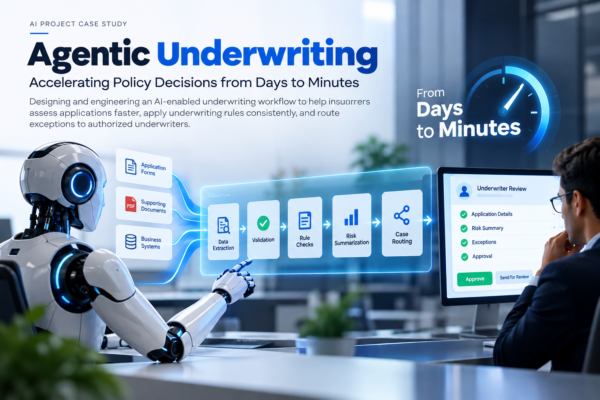
Accelerating Policy Decisions from Days to Minutes
Designing and engineering an AI-enabled underwriting workflow to help insurers assess applications faster, apply underwriting rules consistently, and route exceptions to authorized underwriters.
Project Overview
BEFORE
Manual reviews and fragmented information gathering.
WHAT WE DID
Engineered a coordinated workflow for data extraction, validation, rule checks and case routing.
OUR PROCESS
Discover → Design → Build → Integrate → Validate → Deploy
1. What Was Happening Before
Underwriting teams often need to collect application details, review supporting documents, verify eligibility, validate risk information and follow up on missing or inconsistent data before a policy decision can be made. When these steps are spread across documents, systems and manual handoffs, processing time can increase.
-
Application information spread across forms, documents and business systems.
-
Repeated manual checks against underwriting rules and eligibility criteria.
-
Back-and-forth to resolve missing, inconsistent or unclear information.
-
Straightforward applications waiting in the same queue as complex cases.
-
Limited visibility into case status, delay reasons and outstanding actions.
2. What Joy IT Did
Joy IT’s project approach is to design and implement an agentic underwriting workflow that coordinates the key steps of application assessment. AI agents organize information and execute approved tasks across connected systems, while insurer-defined rules, human-review thresholds and decision authority remain explicit.
-
Application Intake and Extraction: Capture relevant fields from submitted forms and supporting documents.
-
Data Validation and Reconciliation: Compare application details across documents and connected systems; flag discrepancies.
-
Underwriting Rule Checks: Assess case attributes against approved eligibility criteria, guidelines and business rules.
-
Risk Summarization: Assemble key facts, supporting evidence, missing information and exceptions into a structured case summary.
-
Workflow Orchestration: Sequence approved tasks, route complete cases through configured steps and escalate exceptions to underwriters.
-
Traceability: Record inputs, rule outcomes, agent actions, exception reasons and human approvals for review.
3. Our Project Execution Process
01. Discover the Workflow
Map the current underwriting journey, systems, data sources, decision points, turnaround times and common bottlenecks. Establish a baseline for the existing process.
02. Design the Solution
Define agent responsibilities, workflow sequence, underwriting rules, integration needs, security requirements, human-approval thresholds and acceptance criteria.
03. Build the Workflow
Develop the document extraction, data validation, rule-checking, case summarization, orchestration and exception-routing components.
04. Integrate Systems
Connect approved policy administration, CRM, document management and risk-data services through authorized interfaces. Validate data mappings and permissions.
05. Validate Cases and Controls
Test representative applications, missing or conflicting data, edge cases, tool failures and escalation paths with underwriting stakeholders. Compare outputs against agreed expected results.
06. Deploy and Improve
Pilot the workflow in a controlled environment, monitor turnaround time and decision quality, review exceptions, and refine the solution before expanding its use.
4. Project Deliverables
-
Current-state workflow assessment and target-state solution design.
-
Agent orchestration and underwriting workflow components.
-
Document extraction, data validation and discrepancy checks.
-
Approved system integrations and configurable business-rule checks.
-
Structured underwriter case summaries, exception routing and approval controls.
-
Test scenarios, evaluation results, audit trail, monitoring measures and operational documentation.
5. Target Outcome and Business Value
Target: Reduce policy approval turnaround from days to minutes for eligible, low-complexity cases.
This is a target, not a verified result. Actual end-to-end approval time depends on insurer rules, data quality, system integration, product complexity and required human review.
-
Faster triage and processing of complete applications.
-
Less repetitive document review and data entry.
-
More consistent application of underwriting guidelines.
-
Earlier identification of missing information and risk exceptions.
-
Improved case visibility and traceability through structured evidence and audit logs.
6. How Success Is Measured
Compare the agreed baseline with pilot and post-deployment results using measures such as:
-
Average and median application-to-decision turnaround time.
-
Percentage of eligible cases completed within the target time.
-
Document extraction and data-reconciliation accuracy.
-
Agreement between system-supported assessments and qualified underwriter review.
-
Exception and escalation rate.
-
Rework rate and manual interventions per case.
Execution Principle
Automate coordination and routine checks where appropriate; preserve clear human oversight, insurer-defined decision boundaries, secure access and auditable records for cases that require review.