Logo
  • Company
    • About Us
    • Team
    • Partners
    • Clients
  • OFFERINGS
    • AI Services
    • GRC
    • Digital Transformation
    • Infrastructure solutions
      • Cybersecurity Consulting
      • Unified Communication
      • ELV System
      • System Integration
    • Professional Services
    • Mortgage Solutions
  • Culture & Careers
  • KNOWLEDGE HUB
    • Blogs
    • Case Studies
  • Contact Us

From Business Challenge to Engineered Solution

  • Home
  • Blog Details
  • October 26 2026
  • wpusername2304

AI PROJECT
EXECUTION

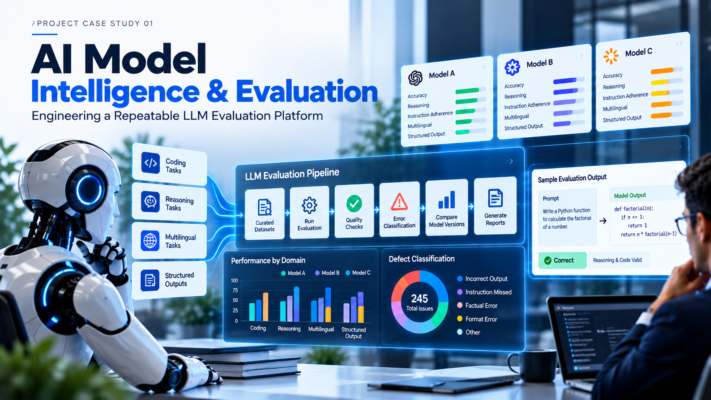
Engineering a Repeatable LLM Evaluation Platform

Project Context

An AI company developing large language models needed a consistent way to evaluate coding, reasoning, multilingual tasks and structured outputs. Different evaluation methods made defects harder to classify and model versions difficult to compare.

Execution Objective

Design and implement a standardized evaluation workflow that creates comparable evidence of model quality across test domains and model releases.

How the Project Is Executed

How the Project Is Executed

01 — Define Evaluation Scope
Agree evaluation domains, quality criteria, scoring rules and acceptance thresholds with stakeholders.

02 — Build the Test Foundation
Create curated prompts, expected responses, edge cases and domain-specific datasets; document annotation instructions.

03 — Implement Evaluation Pipelines
Run model outputs through checks for correctness, instruction adherence, reasoning quality and structured-output validity.

04 — Add Specialist and Human Review
Evaluate coding, Python, JSON and required multilingual cases; apply reviewer quality checks and error classification.

05 — Automate Regression Testing
Compare model versions against a consistent test suite and flag changes in quality or recurring failure patterns.

06 — Report and Iterate
Publish scorecards and benchmark reports, review defects with stakeholders and refine the test suite.


Project Deliverables

  • Curated training and evaluation datasets

  • Annotation guidelines and quality-control procedures

  • Evaluation pipeline and automated regression test scripts

  • Model scorecards, benchmark reports and defect taxonomy

  • Evaluation documentation and review workflow

Expected Business Impact

  • More consistent comparison between model versions

  • Earlier visibility into output defects and failure patterns

  • A repeatable quality-assurance process to support model iteration
Success Measures: Evaluation accuracy; reviewer/annotation agreement; defect detection rate; regression pass rate; cost per evaluated sample.

Relevant Joy IT Capabilities: LLM evaluation specialists, Python/Machine Learning Engineering, LLM QA and AI Quality Analysts.

Previous Post
Agentic Underwriting
Next Post
Safety Data Sheet (SDS) Management Solution

Leave a Comment Cancel reply

Recent Posts

  • Safety Data Sheet (SDS) Management Solution
  • From Business Challenge to Engineered Solution
  • Agentic Underwriting
  • Strengthening IT GRC: Governance, Risk, and Compliance Solutions by JOY IT Solutions
  • Mastering Cyber GRC: Governance, Risk, and Compliance Solutions by JOY IT Solutions

Categories

  • No categories

Recent Comments

    • 2025 JOY IT SOLUTIONS
    • Privacy Policy

    india

    • 21/1, 1st main road, Byappanahalli Extension, Indiranagar, Bengaluru, Karnataka

    UAE

    • Joy IT Consulting LLC, Office No. 1-05, Nasser Lootah Airport Building,
      P O Box 6200, Dubai,
      United Arab Emirates

    USA

    • 1 Radisson Plaza, Ste #800 3rd Floor, New Rochelle New York
    Facebook-f Twitter Instagram 500px
    Facebook-f X-twitter Instagram Linkedin