- October 26 2026
- wpusername2304
A Modern Web-Based Solution for More Organized Compliance and Operations
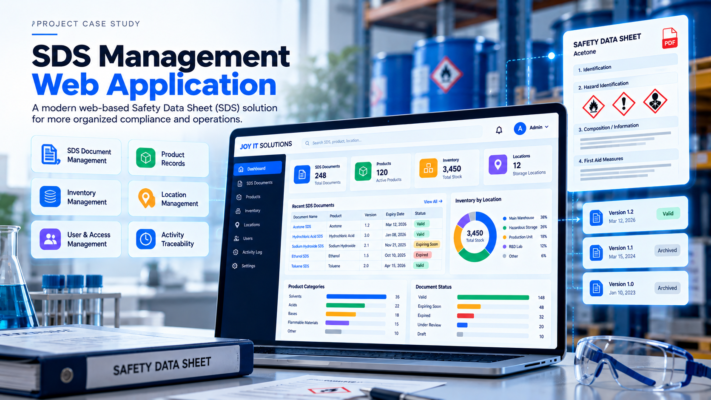
Joy IT Solutions developed a web-based proof of concept to centralize Safety Data Sheets (SDS), product data, inventory, storage locations and user access in one structured application.
Project Overview
WHAT WAS BEFORE
Safety documents and product records were difficult to manage across disconnected files.
WHAT WE DID
Built a web-based proof of concept to centralize SDS documents, product data, inventory, locations and user access.
OUR PROCESS
Discover → Design → Build → Validate → Demonstrate
1. What Was Before
Organizations handling chemicals, hazardous materials and regulated products need reliable access to current Safety Data Sheets (SDS) and related product information. When documents, inventory records and storage details are managed manually or across separate files, teams can spend time locating documents, checking revisions and maintaining records.
Safety documents stored across separate locations or files.
Time-consuming searches for relevant product and safety information.
Limited visibility into document revisions, expiry dates or review requirements.
Product, inventory and storage-location records not managed in one connected view.
Need for controlled user access and traceability of key activities.
2. What Joy IT Solutions Did
Joy IT Solutions developed a proof of concept for a centralized, web-based SDS management application. The solution brings safety documents and related product operations into one structured interface, giving authorized users a common place to manage records and review their status.
Core Application Capabilities
SDS Document Management
Upload, organize and maintain document versions and expiry-related information.
Product and Inventory Records
Maintain product details, stock quantities and configured inventory information.
Location Management
Associate products with relevant storage locations and categories.
User and Access Management
Support authentication and role-based access concepts.
Operational Traceability
Maintain activity history for relevant actions.
Responsive Web Interface
Provide a practical, modular application for day-to-day record management.
3. Our Project Execution Process
01. Discover and Map
Review the document-management needs, key users, product records, location hierarchy and information-access requirements.
02. Design the Solution
Define the application modules, user flows, data structure, access approach and core record relationships.
03. Build the Application
Develop the web interface and database-backed modules for SDS records, products, inventory, locations and user access.
04. Configure Controls
Implement authentication and relevant permission concepts, including database-level access rules where configured.
05. Validate Workflows
Test document upload and retrieval, product-location associations, record updates, access permissions and activity history.
06. Demonstrate the Proof of Concept
Show how the centralized application supports core workflows and identify future enhancements based on business priorities.
4. Project Deliverables
Web-based SDS management proof of concept.
Centralized document and product record modules.
Inventory and storage-location management features.
User authentication and role-based access concepts.
Database-backed application structure and activity history.
Tested core workflows and recommendations for potential next-phase enhancements.
5. Outcome and Business Value
The completed proof of concept established a digital foundation for managing safety documents and related product information in one application. It demonstrates a more structured way to organize records, monitor document status and connect product details with storage locations.
Centralized access to safety documents and related product records.
Improved visibility into document versions and expiry-related information.
A connected view of products, inventory details and storage locations.
More structured user access and operational traceability.
A modular foundation for future integrations and enhancements.
6. How Success Can Be Measured
Impact should be quantified through pilot or deployment data rather than assumed in advance.
Time required to locate the correct SDS document.
Percentage of product records linked to required documentation.
Number of missing or outdated records identified and resolved.
Accuracy and completeness of product and location data.
User feedback and completion time for common tasks.
Application reliability and response time.
Project Execution Principle
Centralize safety documentation and related product operations through a structured web application, while maintaining appropriate access controls, document traceability and a clear path for future enhancements.